
Wednesday, September 22, 2010
End of the line

Tuesday, June 22, 2010
Cincinatti, parking mandates and transit
Minimum parking requirements are destructive to urban areas. They drive up the cost of construction because every new building requires a shadow building for car parking. Then they drive up the cost of living for people who have to pay for the shadow parking structures after construction. They reduce the city tax base because every parking garage replaces businesses or housing that isn't operating there and bringing tax revenue to city coffers. They stifle new business creation when locations that might otherwise work can't provide "X" number of spaces per 1,000 square feet. They destroy the very urban fabric that defines the city by creating vast dead spaces that are hostile to street life.
Parking minimums also have a deleterious effect on transit by incentivizing car driving. Each new 400 space parking garage that goes up downtown represents 400 drivers who have no reason to take transit to work. Every new city housing unit is required to provide one off-street parking space so potential transit riders now have parking on both ends of their commute. Even grocery stores in urban areas are required to provide vast parking lagoons for their customers. Why would people take transit anywhere with so much "free" parking to be had?
If we're going to revive our urban areas (and we will have to in coming decades) we have to make them dense again and that means utilizing all available space for humans- not cars and SUVs. The surface parking lots or "missing teeth" have to be filled in with human-scaled buildings. Maybe we will even be able to reconfigure some of our parking garages for living or work spaces. But we can't do this with our current regime of parking requirements. We also cannot support transit as long as we continue to subsidize car driving to the degree we have over the last 70-80 years. The Natti realizes this, I hope other American cities follow suit (ahem, Richmond.)
Friday, June 4, 2010
Die Partybahn!
I ran some text from their website through Google Translate:
"The party can also train you for the pleasure of own party. Book Birthdays, stag parties, weddings, Semester parties, class reunions, school introductions, youth harriers and confirmations - the party has to train every occasion the very special atmosphere.
You ask by mail (marketing@jenah.de) or by telephone at 03 641 41 41 29 to see if your preferred date is free and set start and destination stop and the duration of voyages.
The hourly rates for the rental of the party train are:
1 hours: 152,00 EUR
1.5 hours: 218,00 EUR
2 hours: 285,00 EUR.
Find out about the food and drinks."
And here is Die Partybahn! in action:


Can't wait to get on the party train!
Saturday, May 8, 2010
Video of Washington, D.C.'s new streetcar
It's strange that the overhead contact wires are so controversial. Tram opponents argue that they will ruin the viewscape of the city, and indeed DC's original trolley system collected power with a scoop from a trench. But overhead wires aside, I think there's a legitimate argument that the streetcar will still have a decluttering effect on the streetscape by way of taking cars off the congested city streets. Like they say, beauty is in the eye of the beholder.
Friday, April 9, 2010
47 Bleicherweg, Zurich

Take a look at this "complete street" in Zurich, Switzerland. Wide sidewalks are sheltered from the elements; a curbside bike lane set off with yellow paint; a single lane for vehicles; a sheltered platform island for tram passengers; a lane for the tram; another tram platform; then two tram lanes; then the opposite sidewalk. Can you think of an American street with three streetcar lanes, a bike lane, and only one lane for cars?
Tuesday, March 16, 2010
A couple bright spots in VA's new budget
-The budget allows the state transportation board to steer money from construction projects to mass transit funding.
-Authorizes new funding for new rail service between Richmond and Norfolk, as well as funding for service between Lynchburg and Washington, D.C.
At this time I can't find any more details about what the first item may mean for transit. I hope it means that money allocated for road construction could move to transit funding, because every transit system in the state is suffering. HRT needs more money for their light rail project, perhaps that is what negotiators had in mind. But that short bullet doesn't make clear if other transit funding is being reduced and this is supposed to cover the shortfall.
Follow the link to a brief discussion of the budget at the Richmond Times-Dispatch.
About the budget
Thursday, March 4, 2010
Thursday, December 17, 2009
Baltimore MTA Light Rail pics
.jpg)
.jpg)
.jpg)
.jpg)

.jpg)
Wednesday, December 2, 2009
USDOT announces $280 mil available for transit projects
U.S. Transportation Secretary Announces $280 Million for Streetcars
First Funds for Administration's Livability Initiative Will Create Jobs
U.S. Transportation Secretary Ray LaHood today announced the availability of $280 million for urban circulator projects such as streetcars, buses, and bus facilities to support communities, expand business opportunities and improve people’s quality of life while also creating jobs.
The money represents the first batch of funding by the Obama Administration for its Livability Initiative, a joint venture of the U.S. Department of Transportation (DOT), U.S. Department of Housing and Urban Development (HUD) and U.S. Environmental Protection Agency (EPA).
“This represents a significant effort to promote livable communities, improve the quality of life for more Americans and create more transportation choices that serve the needs of individual communities,” Secretary LaHood said. “Fostering the concept of livability in transportation projects will stimulate America’s neighborhoods to become safer, healthier and more vibrant.”
Tuesday, November 24, 2009
Long Beach looking at streetcars

From the Long Beach Press-Telegram:
LONG BEACH, Calif. -- Second District City Councilwoman Suja Lowenthal envisions a downtown crowded not with cars, but people - pedestrians who arrive by bicycle, bus and, perhaps, even streetcars.
Electric-powered streetcars such as those used in San Francisco and Portland - connecting Long Beach's neighborhoods, fostering pedestrian movement and spurring development - are an integral part of Lowenthal's vision.
Last week, the council heard a report on a feasibility study that had been commissioned in 2007 about installing streetcars in Long Beach, and other city officials seem to be warming up to the idea.
"We are at a fantastic time in our city when more and more people want to leave their cars behind," Lowenthal said last week. "People are looking for ways to exercise their right to different modes of transportation."
Sunday, November 22, 2009
Thursday, November 19, 2009
DDOT's LRV's leave Czech Republic for USA!

DC's three LRV's produced by Skoda in the Czech Republic in 2007 are officially on the way to the nation's capital!
Read more at BeyondDC blog
********
As an administrative note, I apologize for blog inactivity this fall. My first semester of grad school has been very busy!
Thursday, October 8, 2009
Norfolk takes delivery of its first LRV's!


from PilotOnline:
"Locals were introduced to The Tide light-rail cars today when the first two arrived in Norfolk. The cars traveled cross country by freight train from Siemens Transportation Systems Inc. in Sacramento, Calif."
Follow the link to see video of the new vehicles arriving on location.
VIDEO: Light-rail cars arrive in Norfolk
Friday, September 18, 2009
Va. lawmakers question ignoring local road funding
Va. lawmakers question ignoring local road funding - Forbes.com
RICHMOND, Va. -- Some members of the Virginia Senate's money committee questioned Thursday whether it's wise - or legal - to sacrifice the state's local roads in order to secure federal dollars to maintain and build highways.
Transportation Secretary Pierce Homer told members of the Senate Finance Committee that revenue reductions of $4.6 billion over the next six years have forced the state to choose to go after federal highway funding instead of repairing and improving other roads and bridges.
To qualify for federal funds that contribute $4 for every $1 the state pitches in, Virginia must meet minimum construction requirements. In order to get those, Virginia has reduced funding to maintain state and local roads by 25 percent.
Thursday, September 17, 2009
Tea Party Protesters Protest D.C. Metro Service
Tea Party Protesters Protest D.C. Metro Service - Washington Wire - WSJ
Evidently the Teabag-Birfers feel their 9/12 unity protest was derailed by sub par service on Metrorail. Some complained that Metrorail didn't increase capacity beyond normal weekend levels to accommodate the tens of thousands of protesters who came out. They didn't plan on requiring such a high level of government service for their anti-government rally. Of course none of them will walk away from this thinking Metro deserves a dedicated funding mechanism. Because that is socialist.
Wednesday, September 9, 2009
Tide Light Rail begins station construction
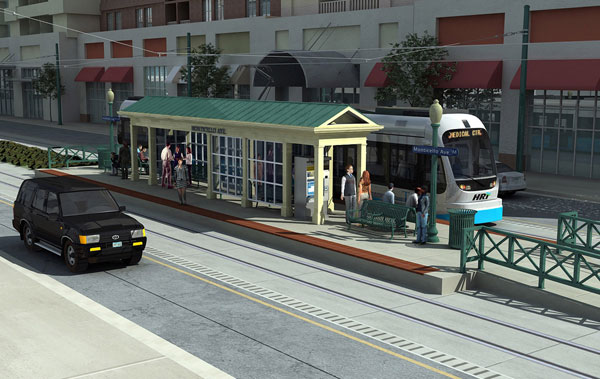
from PilotOnline:
Norfolk light rail stations' look is built on flexibility
"...City officials have decided on a neo classical style for the 11 light-rail station shelters that is designed to fit in historic neighborhoods, including Freemason, as well as more suburban settings, including Ingleside.
"The shelters' appearances will vary, with heavier columns and finishes downtown and lighter, more airy features in the outlying neighborhoods, planning director Frank Duke said. Their size will vary as well, with larger shelters at stations that are projected to carry more passengers.
"Each will have benches, trash cans, lighting and a ticket vending machine.
"They're nice, considering we went at it with a bare-bones perspective," said City Councilman W. Randy Wright, who has championed the rail project.
"The original design was very basic, but council members agreed to enhance the look at the city's expense. Hampton Roads Transit is now advertising for bids to build the stations."
********
I think this neoclassical station design is really unique. I'm not aware of any other US light rail systems that have tried to blend station design with surrounding historic buildings. Largely because existing light rail systems in the US are few and far between, but also because many are in the West where there isn't the same stock of antebellum neoclassical buildings we have in the East- particularly in Virginia. Also, many light rail systems have little to no infrastructure in the way of stations, rather they are simply signed areas on the street for boarding and deboarding.
So it seems that Norfolk may soon have the world's only modern-neoclassical LRT system!
********
By the way- why did the sketch artist for the above illustration choose to draw an SUV in front of the train station?? I guess if they can use bikes to sell SUV commercials they can also use SUV's to sell light rail?
Thursday, August 27, 2009
"High-Speed Boondoggle" by Robert J. Samuelson: the Urban Workshop Re-mix
read on at St Louis Urban Workshop blog
Tuesday, August 25, 2009
VA applies for $75mil for NoVa third track
Virginia seeks $75 million for high speed rail
Virginia is seeking federal stimulus funding for a $74.8 million high-speed rail project in Prince William and Stafford counties.
Gov. Timothy M. Kaine announced yesterday that Virginia has submitted an application for funding for a third set of tracks along an 11.4-mile section of the CSX Corp. rail line between Richmond and Washington.
"The Federal Railroad Administration set very specific criteria for states to compete for this first round of historic federal investment in high-speed rail," Kaine said.
"Virginia has submitted a strong project application and we are ready to begin construction as soon the federal funding is awarded," he said.
The application deadline yesterday was for "ready to go" projects fully supported by both the track owner, CSX in this case, and the service provider, Amtrak. The third set of tracks would stretch from Powell's Creek in Prince William to Arkendale in Stafford. Virginia intends to compete in October for a second round of high-speed rail projects funded by federal stimulus funds. ****************************** Sounds great! This is an interesting section of the route because there are at least three bridges and most of the track is along the Virginia bank of the Potomac River. The train passes some marinas, Possum Point Power Station and goes right through Marine Corps Base Quantico. Virginia Railway Express also uses this entire section of the track so this will increase VRE efficiency as well. Take a look at this Google map of the proposed $74.8mil track work. Also, Transport Politic has posted a complete list of the specific Phase I plans the states have applied for.
Monday, August 24, 2009
Bob Samuelson writes an ugly anti-rail piece in the Post
"HSR won't work in the US because our population density is 86 people per square mile vs Japan's 880/mi2." Wow, if that's not the most stunningly dishonest factoid about density than it is surely the most naive or ignorant. Read the whole piece for a well-rounded array of strawmen, lies and distortions about passenger rail.
Thursday, August 20, 2009
High floor, low floor, bus floor, tram floor!
The photo below shows a San Francisco Muni high platform to illustrate the design problem the two agencies face. Imagine riders climbing up on the platform from a low floor bus.


